
Share This Post
Manufacturer tier is not simply a measure of size or brand recognition. It is a composite assessment of financial stability, manufacturing capacity, global reference installations, standards compliance track record, and after-sales support capability. The right tier for any given project depends on the equipment type, voltage class, project risk tolerance, and schedule constraints — not on brand familiarity.
1. Why Manufacturer Tier Classification Matters in Substation Procurement
The global market for high-voltage substation equipment — particularly power transformers — is highly concentrated at the top end and fragmented at the lower end. A small number of established manufacturers with global manufacturing footprints dominate the large power transformer segment, while a much larger number of regional and local manufacturers compete across all equipment categories and MVA classes.
For EPC procurement teams managing substation projects in the US, the practical question is not which manufacturer is theoretically the best — it is which manufacturers represent the optimal balance of technical capability, delivery reliability, commercial competitiveness, and long-term service support for this specific project, at this voltage and MVA class, on this schedule.
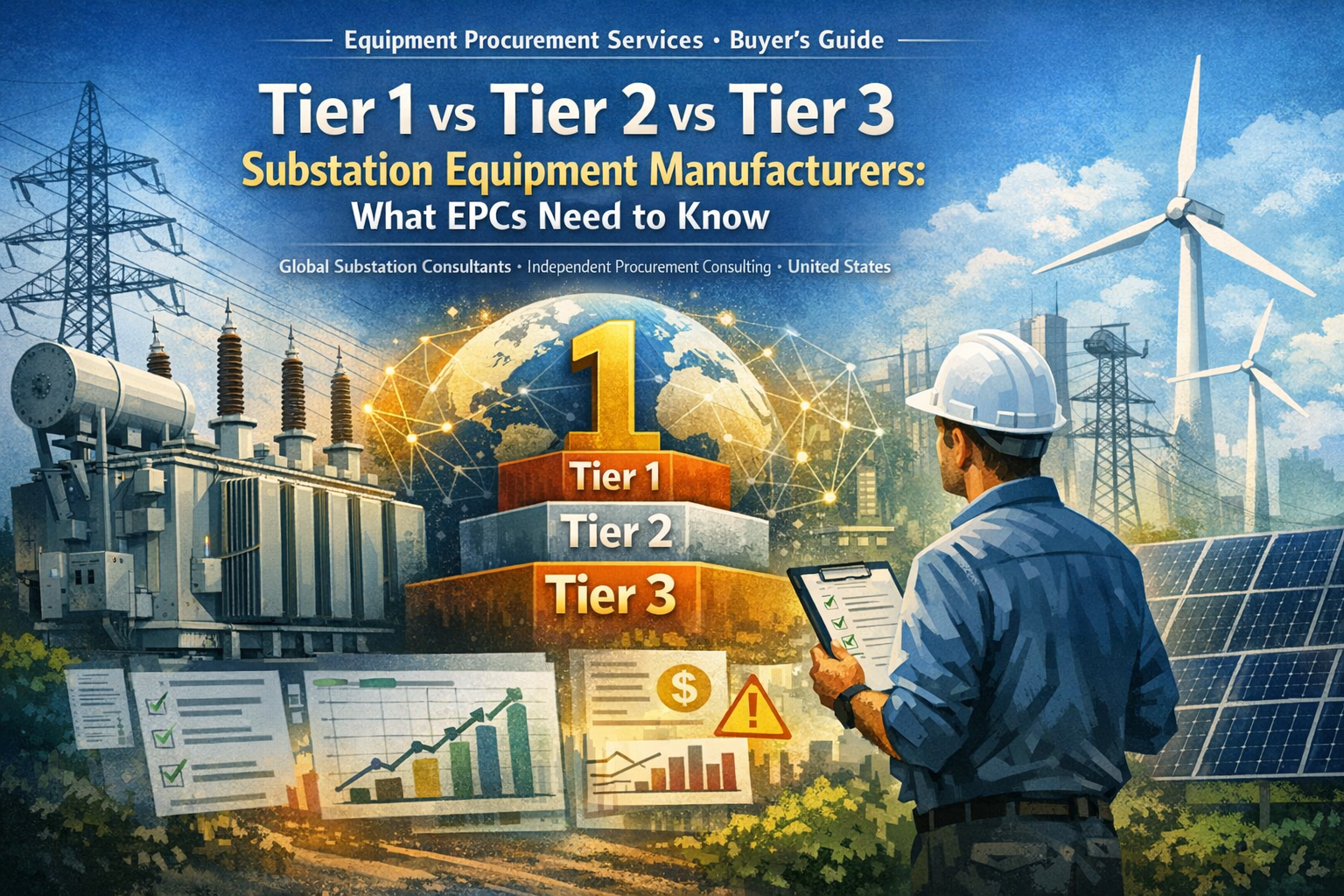
Manufacturer tier classification provides a structured way to answer that question. It segments the global supply base into three groups based on a consistent set of qualification criteria, allowing procurement teams to make defensible, risk-adjusted vendor shortlisting decisions. Global Substation Consultants applies this framework on every procurement advisory engagement for US projects — and the results consistently show that the right tier strategy is project-specific, not a blanket rule.
2. The Tier 1 / Tier 2 / Tier 3 Framework Defined
The following framework reflects how Global Substation Consultants applies tier classification in procurement advisory engagements for US substation projects. It is equipment-agnostic and applicable across power transformers, HV circuit breakers, disconnect switches, and capacitor banks.
Tier 1
Global Benchmark Manufacturers
Tier 1 manufacturers are globally recognized, vertically integrated equipment producers with established manufacturing facilities across multiple continents, decades of operating history, and extensive reference installation databases spanning all voltage classes and MVA ratings. Their products are delivered with full type test documentation, comprehensive factory test capabilities, and dedicated engineering teams for each product line.
Defining characteristics:
- Global manufacturing footprint with facilities in multiple regions (Americas, Europe, Asia)
- Full voltage class coverage from distribution through EHV (up to 765 kV and above)
- Extensive reference list for the US market including utility, EPC, and industrial clients
- In-house type testing facilities (impulse, temperature rise, short circuit) certified to IEEE and IEC
- Dedicated field service and spare parts network in the United States
- ISO 9001 certified manufacturing with established quality management systems
- Financial strength sufficient to support multi-year warranty obligations and liability exposure
- Active participation in IEEE and IEC standards development committees
Tier 2
Established Regional Manufacturers
Tier 2 manufacturers are established companies with proven manufacturing capabilities, typically concentrated in one or two geographic regions. They have solid reference installation histories at their core voltage and MVA classes, generally robust quality systems, and competitive pricing compared to Tier 1. Their global service networks are more limited, and their type test portfolios may have gaps for higher voltage classes.
Defining characteristics:
- Established manufacturing operations in one or two primary geographic regions
- Strong reference list at their core voltage class (typically up to 230 kV or 345 kV)
- IEEE and/or IEC type test documentation for core product range — may have gaps at higher voltage classes
- ISO 9001 certified quality management systems
- Regional field service capability — US coverage may depend on third-party service partners
- Competitive pricing — typically 10–25% below Tier 1 for equivalent specifications
- Adequate financial standing for standard warranty terms — long-term exposure requires assessment
- Active supply to EPCs and utilities in their primary market regions
Tier 3
Emerging and Local Manufacturers
Tier 3 manufacturers are typically smaller, locally focused companies — but this does not mean their equipment is substandard. A number of Tier 3 manufacturers produce large, complex equipment including transformers above 300 MVA with loss performance that is genuinely competitive when independently measured and verified. Their primary commercial advantage is price, and in some cases, faster delivery for specific product ranges.
The risk profile for Tier 3 is higher — but it is a manageable risk with the right procurement framework. Global Substation Consultants’ independent specification writing, FAT witnessing, and drawing review services are specifically designed to bridge the gap between a commercially attractive Tier 3 offer and the technical assurance requirements of a US project.
Key risk factors to assess before including Tier 3 on a bid list:
- Type test documentation completeness — verify for the specific voltage class and MVA rating required
- Reference installation verifiability — US market references are preferred; other market references must be assessed for standards equivalency
- Quality management system status — ISO 9001 certification not always present; independent factory audit may be required
- In-house FAT test capability — reliance on third-party labs is acceptable if the lab is accredited and calibration records are traceable
- US field service and spare parts — contractual provisions for in-country stocking and response time are essential
- Financial standing — performance bond and warranty exposure require independent financial review
3. Side-by-Side Comparison: Tier 1 vs Tier 2 vs Tier 3
The table below compares all three tiers across eleven procurement-relevant criteria. Use this as a quick reference when building your vendor shortlisting strategy.
| Criteria | TIER 1 | TIER 2 | TIER 3 |
|---|---|---|---|
| Manufacturing Footprint | Global — multiple regions | Regional — 1–2 regions | Local — single country |
| Voltage Class Coverage | Full range — up to EHV | Core range — typically to 345 kV | Varies — verified per project |
| US Reference Installations | Extensive — utilities & EPCs | Moderate — varies by region | Limited or unverified |
| Type Test Documentation | Complete — all voltage classes | Complete for core range | Partial or absent — verify |
| ISO 9001 Certification | Always | Usually | Audit required |
| In-House FAT Test Lab | Full capability | Partial capability | Third-party lab reliance |
| US Field Service Network | Established | Partial / partner-based | Minimal — provisions needed |
| Relative First Cost | Highest | 10–25% below Tier 1 | 30–50%+ below Tier 1 |
| Delivery Lead Times | Longest (12–24+ months) | Moderate | Varies — monitor closely |
| FAT Oversight Required | Standard | Enhanced | Intensive — GSC recommended |
| Supply Chain Risk Level | Low | Moderate | Higher — mitigable |
Note: “FAT Oversight — GSC recommended” for Tier 3 means full test procedure review, hold-point witnessing, and independent test report verification before equipment leaves the factory. Global Substation Consultants provides FAT coordination and witness services for all three tiers, scaling scope to the tier risk profile.
4. How to Build Your Manufacturer Shortlist: A Practical Framework
The right vendor shortlist is not a fixed list — it is the output of a structured pre-qualification process applied to the specific requirements of the project. Global Substation Consultants uses the following four-step framework when advising EPC and developer clients on vendor shortlisting for US projects.
4.1. Define the Equipment Classification
Before building a shortlist, establish the voltage class, MVA rating, and criticality level of the equipment. A 345/138 kV, 250 MVA autotransformer for a transmission interconnection project carries fundamentally different supply chain risk than a 34.5 kV, 30 MVA collector substation transformer for a solar project. The tier strategy should reflect this difference explicitly. Global Substation Consultants begins every procurement engagement with an equipment classification review before making any shortlisting recommendation.
4.2. Screen Against Pre-Qualification Criteria
For each potential manufacturer, verify: valid type test reports for the required voltage class and MVA rating, verifiable reference installations (minimum 3–5 units in service for at least 2 years at comparable ratings), active ISO 9001 certification, adequate financial standing, and confirmed production capacity within the required delivery window. Global Substation Consultants’ procurement consulting service covers full pre-qualification screening as a standard deliverable.
4.3. Apply Tier-Based Risk Mitigation Provisions
Apply tier-appropriate risk mitigation in the procurement documents. For Tier 2, this typically means enhanced FAT requirements, mandatory drawing review hold points, and additional contractual provisions for US spare parts stocking. For Tier 3, factory audit rights prior to order award, independent quality inspector presence during manufacture, and enhanced performance bond requirements should be standard. Global Substation Consultants prepares tier-specific risk mitigation language as part of every specification writing and procurement documentation engagement.
4.4. Evaluate Bids on a Like-for-Like Basis
Technical bid evaluation must assess the complete commercial proposition: first cost, loss capitalization, delivery reliability history, after-sales service cost, and contractual terms. A Tier 2 manufacturer offering 15% lower first cost but carrying higher loss values may be the more expensive option when evaluated on total cost of ownership. Global Substation Consultants prepares technical bid evaluation matrices and loss capitalization analyses that allow Tier 1, 2, and 3 proposals to be compared on a true like-for-like basis.
5. Loss Capitalization: Why First Cost Alone Is a Misleading Metric
One of the most common mistakes in substation equipment procurement — regardless of manufacturer tier — is evaluating transformer bids on first cost alone. For power transformers, the capitalized cost of losses over the equipment’s 30-to-40-year operating life frequently exceeds the first cost of the unit itself.
Loss capitalization methodology assigns a dollar value (the capitalization factor, expressed in $/kW) to no-load losses and load losses, allowing bids to be compared on a total evaluated cost basis. A standard utility capitalization formula might assign $5,000/kW to no-load losses and $3,000/kW to load losses. On a 100 MVA transformer, the difference in no-load loss between a low-loss Tier 1 unit and a standard-loss Tier 2 unit — say, 50 kW — translates to $250,000 in capitalized cost difference.
The practical implication: a Tier 2 or Tier 3 manufacturer may offer the best total evaluated cost if their verified loss performance is competitive. Global Substation Consultants develops project-specific loss capitalization formulas and applies them consistently across all bid evaluations — ensuring the procurement decision reflects true lifecycle cost, not just purchase price.
6. The Case for Tier 2 and Tier 3: Why Independent Consultants Don’t Default to Tier 1
One of the most common misconceptions in substation equipment procurement is that Tier 1 is always the safest choice. In practice, this assumption costs projects money, extends lead times unnecessarily, and overlooks a significant portion of the global supply base that is genuinely capable of delivering high-quality, well-performing equipment — when properly evaluated.
What Field Experience With Tier 2 and Tier 3 Equipment Actually Shows
Consultants and EPC engineers who have witnessed factory acceptance tests and reviewed loss measurement data across a broad range of manufacturers — not just the established Tier 1 names — will confirm what the procurement data increasingly shows: a number of Tier 2 and Tier 3 manufacturers are producing equipment with no-load and load loss values that are competitive with, and in some cases better than, the Tier 1 equivalent. The losses are calculated, the measurements are independently verifiable, and the equipment works.
This matters commercially. On a large solar or wind project procuring 20 to 40 GSU transformers, the cost difference between an unquestioned Tier 1 shortlist and a properly pre-qualified Tier 2 or Tier 3 shortlist can reach into the millions of dollars — capital that project developers and EPCs can allocate elsewhere. Refusing to evaluate lower-tier manufacturers on principle is not risk management. It is leaving money on the table.
The key distinction is not which tier the manufacturer belongs to — it is whether the right technical oversight is in place to verify the equipment before it ships. A Tier 3 transformer procured with a complete project-specific specification written by Global Substation Consultants, rigorous FAT witnessing, independent drawing review, and contractual spare parts and warranty provisions can outperform a Tier 1 transformer procured with a generic spec and no witness testing. Process determines outcome, not brand name.
The Qualification Table: Six Criteria That Define Tier — Not MVA Rating
Tier is never determined by MVA rating or voltage class alone. There are Tier 3 manufacturers producing 300+ MVA transformers with competitive loss performance. Tier is entirely a function of the following six qualification criteria, applied to the specific project requirements.
| Qualification Criterion | TIER 1 | TIER 2 | TIER 3 |
|---|---|---|---|
| Type Test Documentation | Complete suite for all voltage classes and MVA ratings bid. Independent test lab reports acceptable if from accredited facility. | Complete for core product range. May have gaps above 345 kV or certain MVA ratings. Must be verified per project. | Partial, absent, or from non-accredited labs. Verify independently — do not accept manufacturer equivalency claims without documentation. |
| Verifiable US Reference Installations | Extensive — multiple units in service with US utilities and EPCs across voltage classes. References readily available. | Moderate — verified references within primary voltage class and region. May be limited for the US market specifically. | Limited or unverifiable. Non-US references must be assessed for standards framework equivalency. |
| Quality Management System | ISO 9001 certified. Established internal quality audit. NCR process with root cause analysis documented. | ISO 9001 certified in most cases. Quality system maturity varies. Third-party audits for critical projects. | ISO 9001 certification not always present. Independent factory audit by GSC or qualified third-party inspector required. |
| In-House FAT Test Capability | Full in-house test lab: impulse, temperature rise, short circuit. Calibration records current and traceable. | Partial in-house capability. Some tests at accredited third-party labs. Acceptable with proper GSC oversight. | Limited or no in-house capability. Full GSC FAT witness and test procedure review essential before shipment. |
| US Field Service & Spare Parts | Established US field service. Spare parts stocked in-country. Warranty response times contractually guaranteed. | Regional service — may rely on third-party partners for US coverage. Contractual spare parts provisions needed. | Minimal US service presence. Contractual in-country stocking obligations and response time SLAs are essential. |
| Financial Standing & Warranty Depth | Strong balance sheet. Performance bond and warranty well-supported. Multi-decade operating history. | Adequate for standard warranty terms. Large warranty claims and long-term exposure require financial review. | Highest-risk variable. Independent financial review and enhanced performance bond requirements are non-negotiable. |
Tier 1 is not always the right answer. Tier 2 and Tier 3 manufacturers, when properly pre-qualified and supported with independent technical oversight throughout the procurement cycle, can deliver equipment that meets specification, performs within guaranteed loss limits, and represents significantly better value for money. The job of an independent consultant like Global Substation Consultants is to make that outcome possible — not to steer clients toward the most expensive option by default.
7. Tier Strategy for Renewable Energy Projects
Utility-scale solar and wind projects in the US have introduced a new dynamic into substation equipment procurement. The volume of equipment required per project — particularly GSU transformers and collector substation equipment — combined with cost pressure from developer IRR targets has pushed many renewable EPCs toward Tier 2 and Tier 3 manufacturers. Global Substation Consultants works with renewable energy EPCs and developers on Tier 2 and Tier 3 procurement for US projects, providing the specification writing, FAT coordination, and drawing review services that make these strategies technically sound.
Harmonic Loading Qualification
The transformer must be designed and tested for harmonic currents from inverter-based generation per IEEE C57.110. Tier 2 and Tier 3 manufacturers may not have standard product designs that account for harmonic loading. Global Substation Consultants includes explicit harmonic loss calculation requirements in all renewable energy transformer specifications.
Delivery Program Reliability
Renewable energy projects often have hard interconnection agreement in-service dates with financial penalties for delay. Tier 3 manufacturers carry higher delivery program risk. Global Substation Consultants drafts procurement contracts with liquidated damages, performance bonds, and independent production monitoring provisions as standard for Tier 3 engagements.
Spare Parts Availability
Collector substation transformers on large solar or wind projects can number in the dozens. A Tier 3 manufacturer with no US spare parts stock creates an operational risk that must be addressed through contractual stocking requirements. Global Substation Consultants specifies in-country spare parts obligations and minimum response time SLAs in all Tier 3 procurement packages.
IEC to IEEE Equivalency
Many Tier 2 and Tier 3 manufacturers targeting the US renewable energy market propose equipment designed to IEC 60076 rather than IEEE C57.12.00. Global Substation Consultants’ specification writing service requires explicit demonstration of IEEE equivalency for all critical parameters — insulation levels, temperature rise basis, loss reference temperatures, and impedance tolerances.
8. How Global Substation Consultants Supports Your Vendor Shortlisting and Procurement
Global Substation Consultants provides independent equipment procurement consulting services to EPCs, renewable energy developers, utilities, and industrial project owners across the United States. Our procurement advisory service covers the full cycle — from vendor pre-qualification and shortlisting through RFQ management, technical bid evaluation, and purchase order award support.
As a fully independent firm with no manufacturer affiliations and no commercial incentives to favor any vendor, Global Substation Consultants is uniquely positioned to evaluate Tier 1, Tier 2, and Tier 3 manufacturers on equal footing — recommending the best-qualified, best-value option for each specific project.
Ready to build a procurement strategy that works across all three tiers?
Global Substation Consultants provides independent procurement consulting for substation equipment projects across the United States — for EPCs, utilities, renewable energy developers, and industrial project owners.