
Share This Post
This guide covers the complete substation equipment procurement process for utility-scale renewable energy projects in the US — from equipment identification through purchase order award and factory acceptance testing — and explains how Global Substation Consultants supports developers, EPCs, and owner’s engineers at every stage of the procurement cycle.
The single most common procurement failure on renewable energy substation projects is starting the equipment procurement process too late. With large power transformer lead times currently running 12 to 24 months in the US market, a procurement process that begins after the interconnection agreement is executed — rather than in parallel with it — creates a hard schedule conflict that no amount of expediting can fully resolve. Global Substation Consultants recommends initiating transformer procurement no later than the Notice to Proceed on the EPC contract, and ideally earlier.
1. The Substation Equipment Scope on a Typical Renewable Energy Project
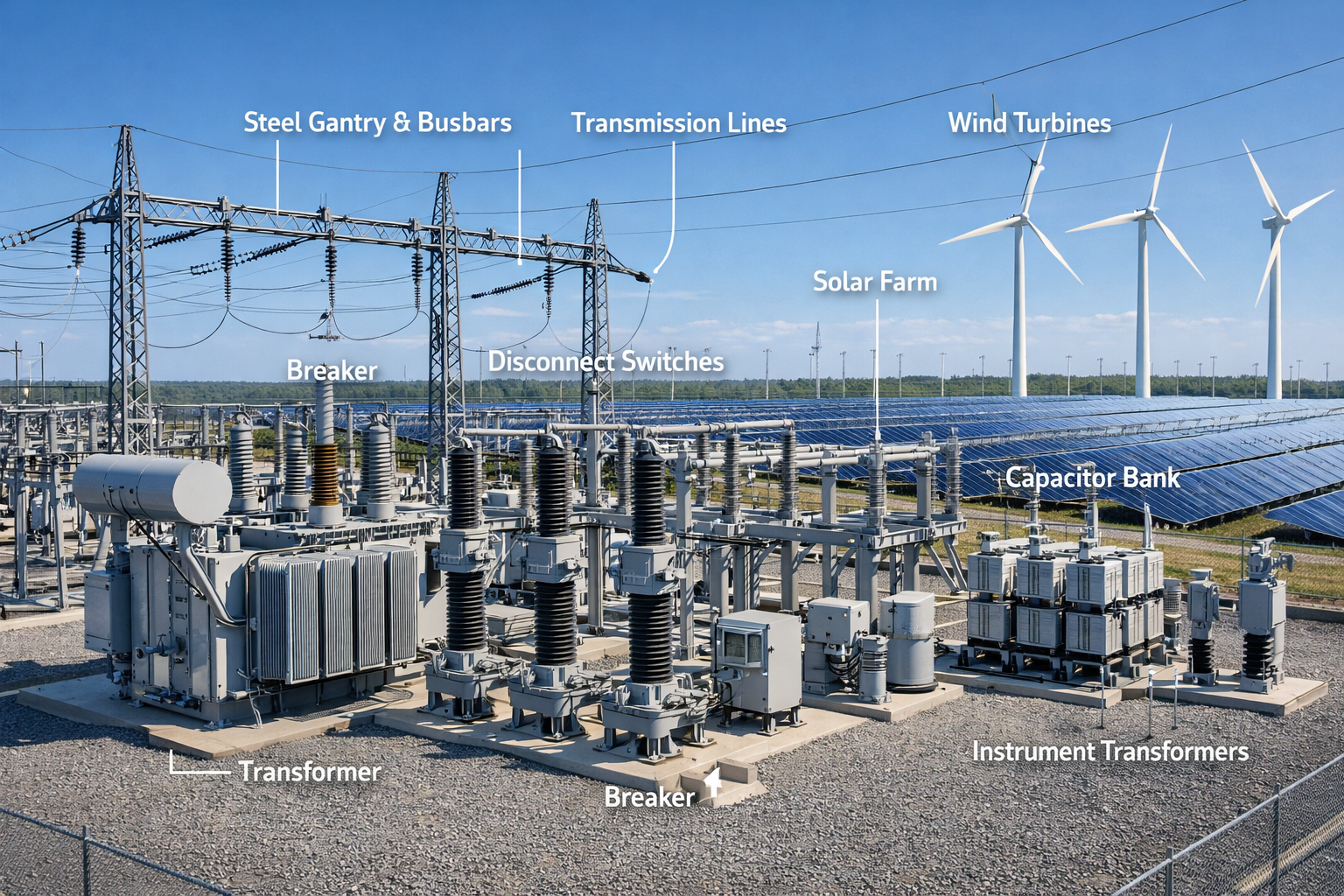
Understanding the complete equipment scope is the starting point for any renewable energy substation procurement plan. The scope varies by project type — utility-scale solar PV, onshore wind, and battery energy storage systems (BESS) have different substation configurations — but all three share a common set of core equipment categories that require procurement management.
Generator Step-Up (GSU) Transformer
Steps up the voltage from the inverter or turbine output to the collector substation bus voltage. One or multiple GSU transformers per project depending on layout.
- Rating range: 5 MVA to 300 MVA, 34.5 kV to 115 kV or 230 kV or 345 kV
- Must be specified for harmonic loading per IEEE C57.110
- Variable load profile requires thermal modeling per IEEE C57.91
- Longest lead time item — initiate procurement before NTP
Collector Substation Power Transformer
Steps up from the collector bus (34.5 kV) to the transmission interconnection voltage (115 kV, 138 kV, 230 kV, or 345 kV). The primary transformer at the point of interconnection.
- Rating range: 30 MVA to 300+ MVA, 34.5 kV to 345 kV
- Often the highest-cost single equipment item on the project
- NERC FAC-001 and FAC-002 compliance requirements apply
HV Circuit Breaker
Transmission-voltage circuit breakers at the collector substation HV bus. Global Substation Consultants manages full procurement — from specification writing aligned to IEEE C37.04 and fault study results through vendor selection, bid evaluation, and FAT coordination.
- Rated per IEEE C37.04 and C37.06 — voltage class from 34.5 kV to 345 kV
- Interrupting current, X/R ratio, and TRV verified against system fault study
- TRV requirements verified for capacitor bank switching duty
- Timing and contact resistance verified at FAT per C37.09
Capacitor Banks
Switched or fixed capacitor banks for reactive power compensation and voltage support at the point of interconnection. Required on most projects to meet utility interconnection reactive power requirements.
- Size and configuration determined by interconnection study
- Switching transients require coordinated circuit breaker selection
- Fuse and protection coordination critical for reliable operation
- Often procured as a packaged assembly with controls
Disconnect Switches and Earthing Switches
Isolation switching for maintenance, sectionalizing, and bus configuration in the collector substation. Motor-operated switches are standard for remotely operated substations.
- Rated per IEEE C37.32 for voltage, continuous current, and fault current
- Bus transfer current switching capability required for bus-tie switches
- ASCE 7 wind and ice loading for the project location
- IEEE 693 seismic qualification for applicable zones
Instrument Transformers (CTs and VTs)
Current and voltage transformers for protection relay inputs, revenue metering, and SCADA monitoring. CT accuracy class and ratio must be selected in strict accordance with the grid owner’s protection requirements and interconnection rules, where applicable — these override the generic IEEE C57.13 defaults.
- CT accuracy class per IEEE C57.13 — C-class selected for fault level
- Revenue metering CTs per IEEE C57.13.6, ANSI C12.20, and utility interconnection agreement requirements
- CT ratios verified against relay coordination study
- Polarity and grounding verified per IEEE C57.13.3
- CT selection must comply with grid owner interconnection rules and protection requirements where specified — these take precedence over generic IEEE C57.13 defaults
Global Substation Consultants manages procurement for all of the above equipment categories as part of the renewable energy substation procurement consulting service — from initial specification development through vendor pre-qualification, RFQ management, bid evaluation, and purchase order award support.
2. Lead Times: The Single Biggest Risk in Renewable Energy Substation Procurement
Transformer and switchgear lead times have extended significantly in the US market over the past several years, driven by record demand from grid modernization programs, data center growth, and the renewable energy build-out. For renewable energy developers and EPCs, this creates a hard scheduling constraint that must be planned around from the earliest stages of project development — not treated as a procurement execution problem after the EPC contract is signed.
| Equipment | Current US Lead Time | Risk Level | Mitigation Strategy |
|---|---|---|---|
| Large collector substation transformer (>100 MVA, 230 kV+) | 18 – 24+ months | Critical | Initiate procurement at or before NTP. Consider split specification — lock in slot with preliminary spec, finalize parameters within 60 days. |
| Medium power transformer (30 – 100 MVA, 69 – 138 kV) | 12 – 18 months | High | Initiate RFQ at earliest possible stage. Complete specification before interconnection agreement finalization to allow parallel procurement tracks. |
| GSU transformer (5 – 30 MVA, 34.5 kV) | 8 – 14 months | Moderate | Procure as a block order for the full project quantity to maximize manufacturer scheduling priority and minimize unit cost. |
| HV circuit breaker (115 kV – 345 kV) | 10 – 18 months | Moderate | Issue RFQ alongside transformer procurement. Breaker lead times have extended — do not assume availability at short notice. |
| Capacitor bank assembly | 6 – 12 months | Moderate | Confirm reactive power requirements from interconnection study before specifying. Premature procurement before study completion risks re-procurement. |
| Disconnect switches | 4 – 8 months | Lower | Coordinate with HV breaker procurement — often procured from the same or allied manufacturer to ensure mechanical interface compatibility. |
| Instrument transformers | 3 – 6 months | Lower | Finalize CT ratios after relay coordination study is complete — not before. Incorrect CT ratio on purchased CTs is expensive to correct. |
Global Substation Consultants develops a project-specific procurement schedule at the start of every engagement — mapping each equipment category’s lead time against the project’s interconnection milestone dates and construction schedule to identify the critical path equipment and the latest acceptable date for RFQ issuance. This schedule becomes the governing document for procurement timing decisions throughout the project.
3. Renewable Energy-Specific Specification Requirements
Substation equipment specifications for renewable energy projects must address operating conditions and performance requirements that differ fundamentally from conventional utility substation applications. Global Substation Consultants includes the following renewable energy-specific requirements in every specification written for solar, wind, and BESS substation projects.
Harmonic Loading — IEEE C57.110
Inverter-based generation sources — solar PV inverters, wind turbine converters, and BESS inverters — produce harmonic currents that increase transformer losses and temperature rise above the values calculated for a purely sinusoidal load. IEEE C57.110 provides the methodology for calculating the transformer’s K-factor and derating requirements based on the harmonic current spectrum from the inverter.
Global Substation Consultants requires the inverter manufacturer’s harmonic current spectrum data to be provided to the transformer manufacturer as a specification input — and requires the manufacturer to perform and submit IEEE C57.110 calculations confirming the transformer is adequate for the actual harmonic loading before the design is approved for manufacture.
Variable Load Profile — IEEE C57.91
Solar projects cycle from zero to full load and back to zero every day. Wind projects experience irregular loading patterns driven by wind speed variability. Both profiles are fundamentally different from the relatively steady loading of a utility distribution substation. IEEE C57.91 provides the thermal model framework for evaluating transformer hot-spot temperature under non-standard load profiles.
For large collector substation transformers, Global Substation Consultants requires the manufacturer to perform a daily thermal cycle simulation using the project’s expected generation profile and the site’s ambient temperature range — confirming that peak hot-spot temperatures remain within IEEE C57.91 limits and that insulation life consumption is acceptable over the transformer’s rated life.
High-Altitude Site Derating
Many utility-scale solar and wind projects in the US Southwest, Great Plains, and Mountain West are located at elevations above 3,300 feet (1,000 meters). At these elevations, air-cooled equipment must be derated to account for reduced air density. For liquid-immersed transformers, the cooling system must be confirmed adequate for the site altitude and maximum ambient temperature combination — particularly for ONAF and OFAF cooled units where forced-air coolers are affected by altitude.
Global Substation Consultants includes site altitude and maximum ambient temperature as mandatory specification inputs and requires the manufacturer to confirm cooling system adequacy with supporting calculations before Approved for Manufacture status is issued.
Anti-Islanding Protection Interface
Interconnection agreements for renewable energy projects require anti-islanding protection — the ability to detect islanded operation and trip the generation source rapidly to prevent uncontrolled energization of the transmission or distribution system. The transformer specification must define the trip signal inputs, breaker failure scheme interface, and any SCADA or IEC 61850 communication requirements for the anti-islanding protection system.
Environmentally Sensitive Site Requirements
Renewable energy projects are frequently sited in environmentally sensitive areas — near water bodies, wetlands, or habitats that require special handling in the event of an oil spill. For these sites, Global Substation Consultants evaluates the option of biodegradable dielectric fluid (FR3 natural ester or equivalent) and includes the necessary material compatibility, sealing, and fire protection requirements in the transformer specification if FR3 is adopted.
4. The Renewable Energy Procurement Cycle: Step by Step
A well-managed substation equipment procurement cycle for a renewable energy project follows a defined sequence of steps. Global Substation Consultants manages the following process on behalf of developer and EPC clients.
Equipment Scope Definition and Procurement Schedule
Define the complete equipment list, preliminary ratings, and required delivery dates for each item. Map lead times against the project interconnection milestone and construction schedule to identify critical path items. Establish the latest acceptable RFQ issuance date for each equipment category. This step should occur at or before Notice to Proceed — not after.
Specification Development
Prepare project-specific technical specifications for each equipment category, incorporating site conditions (altitude, ambient temperature, seismic zone, wind/ice loading), system parameters (fault level, X/R ratio, system voltage), renewable energy-specific requirements (harmonic loading, variable load profile, anti-islanding interface), and commercial provisions (loss capitalization, warranty terms, spare parts requirements). Global Substation Consultants prepares specifications that are immediately ready for RFQ issuance — not drafts requiring further internal revision.
Vendor Pre-Qualification and Shortlisting
Screen potential manufacturers against minimum pre-qualification criteria: type test documentation for the required voltage class and MVA rating, verifiable US reference installations, active ISO 9001 certification, adequate financial standing, and confirmed production capacity within the required delivery window. For renewable energy projects, also verify the manufacturer has experience with harmonic loading calculations and variable load profile thermal modeling. Global Substation Consultants conducts pre-qualification assessments across Tier 1, 2, and 3 manufacturers globally.
RFQ Issuance and Management
Issue the request for quotation with the technical specification, commercial terms, and bid form. Manage the RFQ process — distributing to shortlisted manufacturers, tracking bid receipt, issuing technical clarification responses to all bidders simultaneously to maintain bid fairness, and receiving and logging complete bids before the bid deadline. Global Substation Consultants manages RFQ processes on behalf of clients — acting as the technical point of contact with manufacturers throughout the bidding period.
Technical Bid Evaluation
Evaluate received bids against the specification on a like-for-like basis. Prepare a technical bid evaluation matrix covering compliance with all specification requirements, technical exceptions and deviations, guaranteed performance values (losses, impedance, operating times), proposed delivery program, and FAT scope. Apply loss capitalization methodology to compare transformer bids on total evaluated cost rather than first cost. Global Substation Consultants prepares independent bid evaluation reports that are defensible to the project owner, lender, and interconnection authority.
Technical Clarification and Negotiation
Issue technical clarification requests to manufacturers on non-compliant or unclear bid items. Evaluate manufacturer responses and update the bid evaluation matrix. For shortlisted manufacturers, conduct technical alignment meetings to resolve remaining deviations before commercial negotiation begins. Global Substation Consultants represents the client in technical alignment meetings — ensuring that commercial pressure does not result in technical concessions that compromise equipment performance.
Purchase Order Award and Technical Kick-Off
Review purchase order technical terms before award to confirm all specification requirements and clarification responses are captured correctly. Conduct a technical kick-off meeting with the selected manufacturer within two weeks of PO award to confirm understanding of key technical requirements, the drawing submission schedule, and the FAT plan timeline. Global Substation Consultants attends technical kick-off meetings on behalf of clients and prepares a formal minutes document that becomes part of the contract record.
Drawing Review and FAT Coordination
Manage the manufacturer’s drawing submission and review cycle — reviewing GA drawings, wiring diagrams, nameplate drawings, CT drawings, and FAT procedures against the specification and applicable IEEE standards. Coordinate the factory acceptance test — reviewing the FAT plan, witnessing mandatory tests, managing the punch list, and issuing the independent FAT report and shipment release recommendation. Global Substation Consultants provides integrated drawing review and FAT coordination services that maintain continuity from specification through shipment.
Securing good equipment for a renewable energy project does not depend on the technical specification alone. Delivery conditions — confirmed slot availability, liquidated damages for late delivery, and milestone-based payment terms tied to manufacturing progress — and warranty conditions — scope of coverage, response time obligations, and in-country spare parts stocking — are equally critical. A technically perfect specification tied to weak commercial terms leaves the project owner exposed when a manufacturer misses a delivery date or disputes a warranty claim. Global Substation Consultants drafts and reviews the commercial provisions of every procurement package alongside the technical specification.
5. Vendor Selection Strategy for Renewable Energy Projects
The cost pressure on renewable energy projects — driven by power purchase agreement (PPA) pricing, interconnection cost caps, and developer IRR targets — creates a strong incentive to explore Tier 2 and Tier 3 manufacturers for substation equipment, particularly for GSU transformers and collector substation switchgear where the unit count per project can be large.
This strategy is commercially sound when executed with the right technical oversight framework. Global Substation Consultants has evaluated and supported Tier 2 and Tier 3 manufacturer procurement on multiple renewable energy projects and has verified that competitive loss performance and specification compliance are achievable across a broader supply base than a Tier 1-only procurement strategy would suggest.
What to Evaluate Beyond Price
- Harmonic loading experience: Has the manufacturer previously supplied transformers for inverter-based generation applications? Do they have established procedures for IEEE C57.110 harmonic loss calculations, or will this be new territory for their design team?
- Delivery program reliability: Does the manufacturer have confirmed production slot availability within the required window? Request a production schedule reference from a comparable recent project — not just a quoted delivery date.
- US spare parts and service capability: For a project with 20 to 40 GSU transformers, the manufacturer’s ability to supply spare parts and provide on-site technical support in the US is a material operational consideration. Contractual in-country stocking requirements should be standard for any Tier 2 or Tier 3 supplier on a renewable energy project.
- FAT capability and history: Can the manufacturer’s factory conduct the full FAT scope required by the specification — including FRA baseline, DGA, and partial discharge? Or will they rely on third-party test labs? Independent test lab use is acceptable but adds coordination complexity and schedule risk that must be accounted for.
- Block order pricing and delivery advantage: For projects procuring multiple identical GSU transformers, manufacturers will often offer meaningful price reductions and schedule priority for block orders of three or more identical units. Global Substation Consultants structures RFQs to capture block order pricing explicitly in the bid comparison.
6. Common Procurement Mistakes on Renewable Energy Substation Projects
Based on Global Substation Consultants’ experience across US renewable energy substation procurement engagements, the following are the most frequent and costly mistakes made by developers and EPCs.
Procurement initiated after the interconnection agreement is signed — rather than in parallel — creates a schedule deficit that cannot be recovered without either accepting delay penalties under the interconnection agreement or paying premium prices for expedited manufacturing slots. The interconnection agreement in-service date is fixed. The transformer lead time is fixed. The procurement start date is the only variable.
A specification copied from a previous project — or adapted from a generic template — will contain parameters that don’t match the new project’s system voltage, fault level, altitude, or seismic zone. Every manufacturer who reads the specification will identify the inconsistencies and either submit deviations or interpret requirements in their favor. Project-specific specifications written by Global Substation Consultants eliminate this problem at the source.
A transformer designed without harmonic loading analysis will run hotter than the nameplate temperature class under actual inverter loading. Over time this accelerates insulation aging and reduces transformer life. The fix after installation is either accepting reduced loading capacity or returning the transformer to the factory — both costly compared to specifying correctly at the outset.
On a 100 MVA collector substation transformer operating for 30 years, the difference in capitalized losses between a low-loss and a standard-loss design can exceed $500,000 USD. A bid that appears to offer the best price on the purchase order may be the most expensive option over the project’s operating life. Global Substation Consultants applies loss capitalization to every transformer bid evaluation.
CT ratios must be determined from the relay coordination study — not assumed from nominal fault levels. Purchasing instrument transformers before the relay coordination study is complete risks buying CTs with the wrong ratio, accuracy class, or knee-point voltage, requiring replacement or a relay settings revision that may not be technically feasible.
The cost savings from using Tier 2 or Tier 3 manufacturers are only realized if the equipment meets specification when it arrives on site. Without independent FAT witnessing, there is no verification of loss values, impedance, operating times, or protection wiring before the equipment leaves the factory. Global Substation Consultants provides FAT witness services that protect the project owner regardless of manufacturer tier.
7. The Role of Independent Procurement Consulting on Renewable Energy Projects
Renewable energy developers and EPCs managing their first US substation procurement — or managing multiple concurrent projects — consistently benefit from independent procurement consulting for one fundamental reason: substation equipment procurement is a specialized discipline that requires current, equipment-specific knowledge of IEEE standards, the global manufacturer supply chain, and the commercial structures that govern US power equipment purchasing.
Global Substation Consultants provides this expertise as a fully independent consulting partner — with no manufacturer affiliations, no preferred supplier agreements, and no commercial incentive to favor any vendor. Our independence means our specifications are written for the project, our bid evaluations reflect what the bids actually show, and our FAT reports document what the test results actually measured.
For renewable energy projects specifically, the value of independent procurement consulting compounds across the project portfolio. A developer managing five projects simultaneously cannot afford to have specialist procurement knowledge tied up on one project — and cannot afford the schedule and cost consequences of a procurement error on any of them. Global Substation Consultants provides the specialist depth across the full procurement cycle that allows developer and EPC teams to focus on what they do best while ensuring substation equipment procurement is managed correctly.
Ready to start your renewable energy substation procurement?
Global Substation Consultants provides independent procurement consulting for utility-scale solar, wind, and BESS substation projects across the United States.